D.A. McCullagh
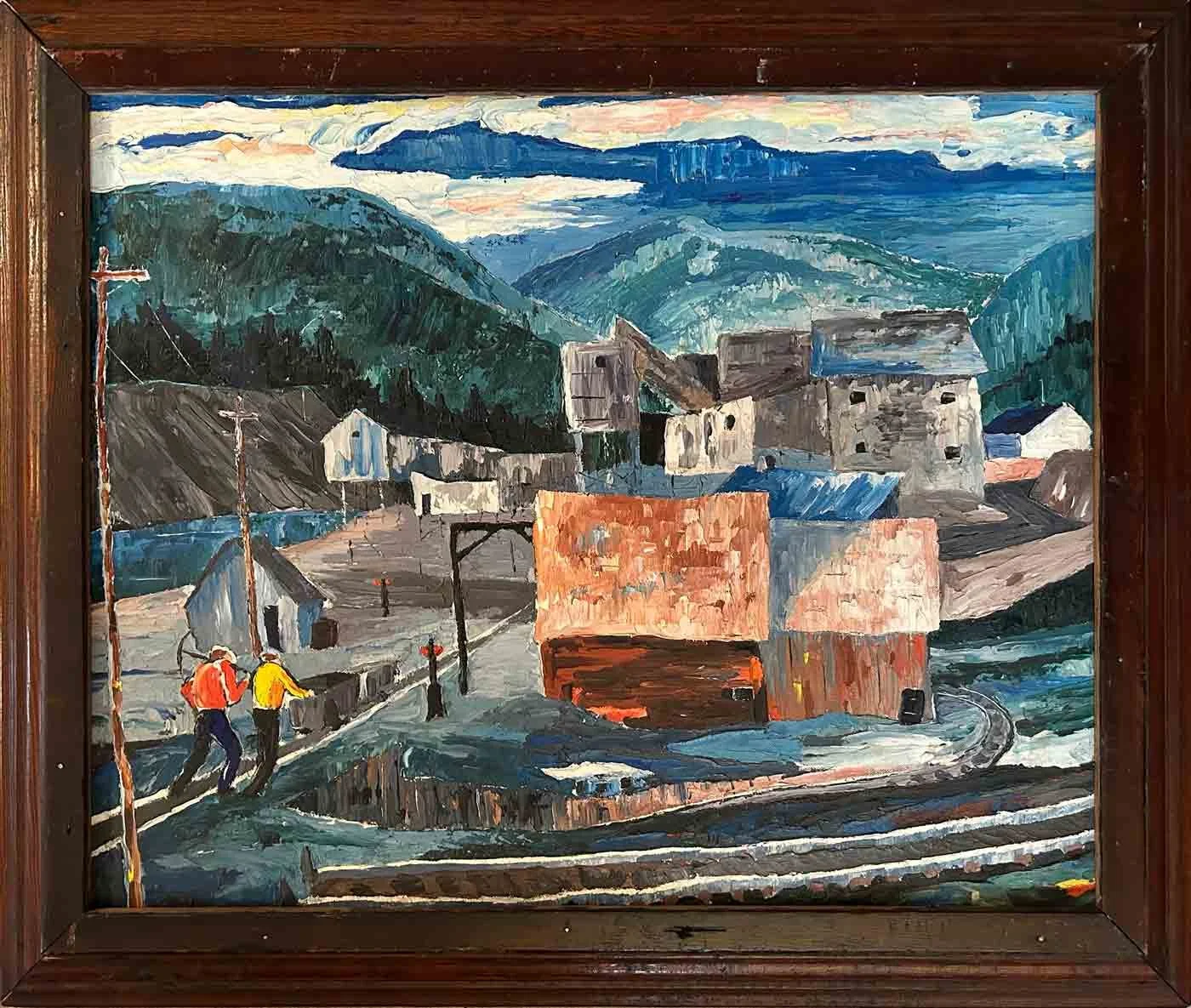
Untitled Industrial Landscape
David Angus McCullagh
Paint on board, 1965
Untitled Industrial Landscape — David Angus McCullagh
Paint on board, 1965
Signed lower right “D. McCullagh ’65”
Addressed on back: 10525 Saskatchewan Drive, Edmonton, Alberta
Purchased at Lakedell Ag Society community garage sale, May 2023
This painting depicts an industrial or infrastructural landscape set against rolling hills and a dramatic sky. Blocky buildings, rail or road corridors, utility poles, and simplified figures are arranged in bold planes of colour. Two small figures in high-visibility jackets walk along a roadway, grounding the scene in lived, working space rather than abstraction alone.
The paint handling is assertive and physical, with visible brushstrokes and palette-knife–like application in places. Forms are simplified and angular, suggesting the influence of mid-century modernism while remaining anchored in representational subject matter. The composition emphasizes construction, movement, and the built environment rather than pastoral calm.
The work is signed and dated 1965, a period when Edmonton was undergoing significant growth and infrastructural change. The address written on the back places the artist in the Saskatchewan Drive area—overlooking the river valley—at the time the painting was made.
The artist, David Angus McCullagh (1937–2019), worked in the Edmonton Planning Department during the late 1960s and early 1970s. He was remembered by colleagues as thoughtful, principled, and deeply connected to the landscapes of Alberta, particularly the Tawatinaw Valley.
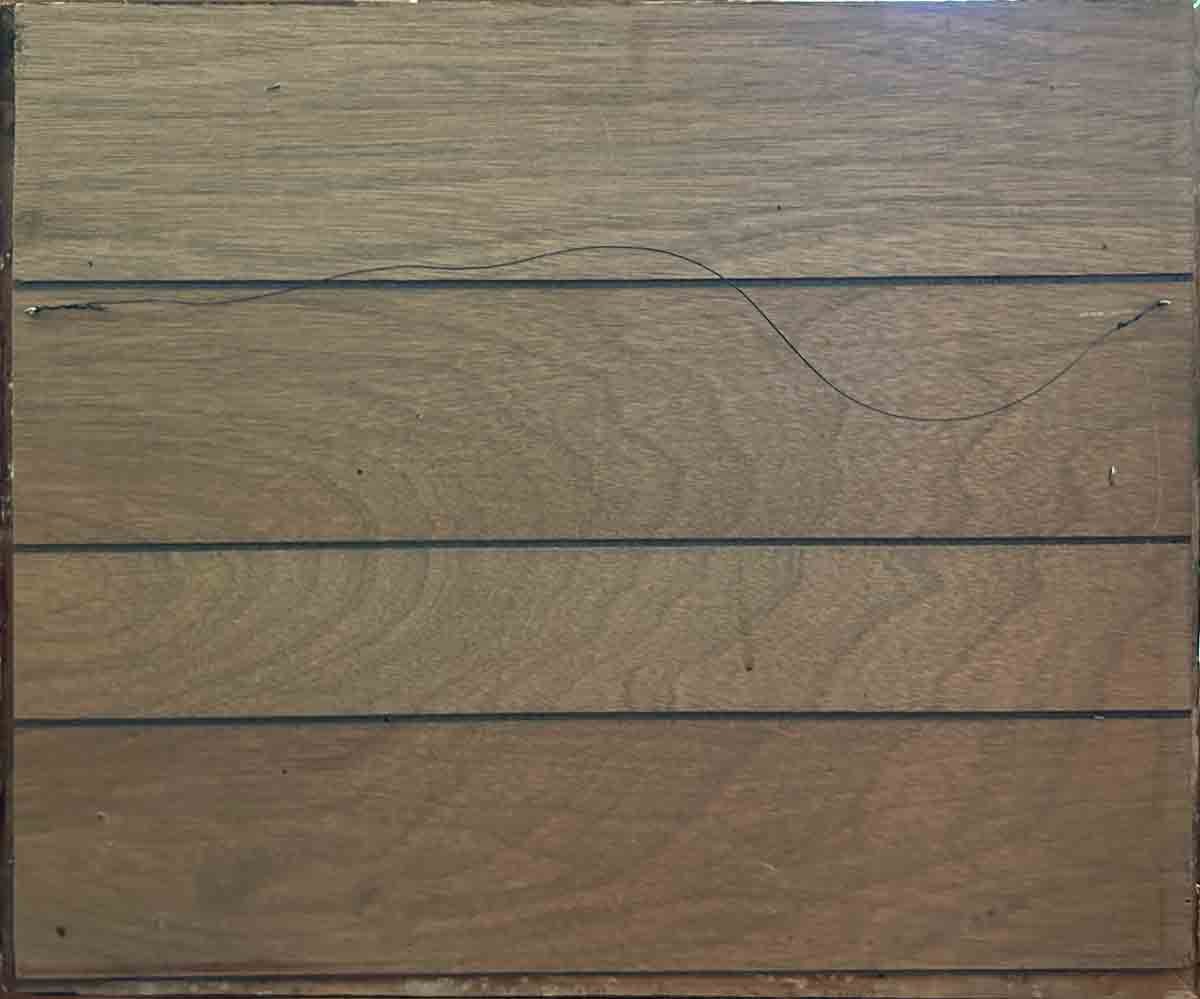
Back of Untitled Industrial Landscape
by David Angus McCullagh
This painting matters because it shows how civic life can surface quietly through art.
David McCullagh was not a professional artist, but he was deeply engaged with place—through planning, through community, and through looking. In 1965, Edmonton was a city in motion: expanding road networks, industrial corridors, utilities, and neighbourhoods. This painting doesn’t romanticize that change, nor does it criticize it. Instead, it observes it from within.
The figures are small. The buildings are heavy. The land is still present, but reshaped. What emerges is a view of modernity that feels lived-in rather than theoretical—a working landscape seen by someone who helped shape it by day, and then returned to it with paint.
The address on the back transforms the painting into a document. It anchors the work to a specific vantage point and a specific life. This wasn’t made for exhibition or legacy. It was made because the act of translating experience into form mattered to the person making it.
As a collector, I’m drawn to this piece because it complicates the idea of who gets to record history. This isn’t an official plan, report, or photograph. It’s a personal rendering of the city at a particular moment, made by someone whose professional role was to think about how cities function—and whose private impulse was to feel his way through that reality with paint.
This painting reminds us that cities are shaped twice:
once by policy and infrastructure,
and again by the people who live inside them and take the time to look.