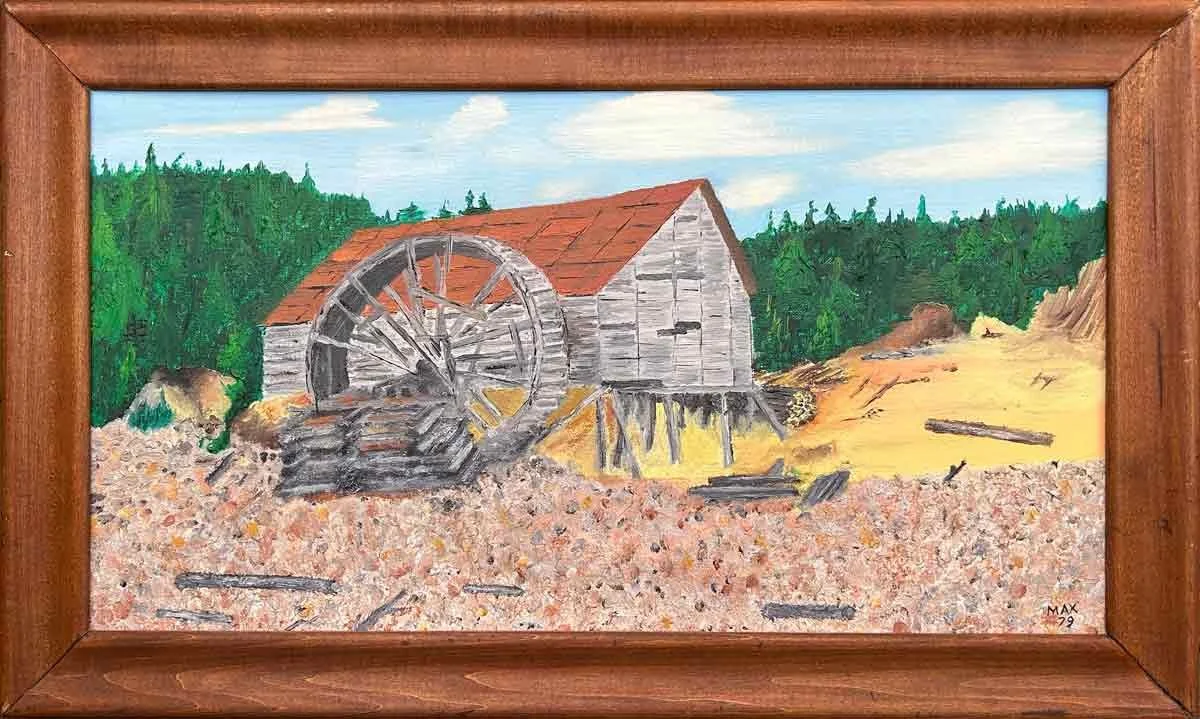
Deep Bight Sawmill, 1979
Artist: Max (unidentified)
Date: 1979
Subject: Deep Bight Sawmill, Newfoundland, Canada
Dimensions: 24” × 13” unframed, 27.5” x 16.5” framed
Signed simply “MAX 79,” this painting depicts the historic Deep Bight Sawmill near Clarenville, Newfoundland. What initially appeared to be a charming landscape turned out to be a remarkably recognizable record of a once-famous Canadian landmark.
The sawmill was constructed in 1905 by William Avery, his sons and his brother James, using primarily locally harvested spruce. Its most distinctive feature was an enormous wooden waterwheel measuring 19 feet in diameter, which powered the machinery used to cut timber. During its busiest years, the mill reportedly processed approximately 3,000 logs annually, producing lumber for construction, boats, furniture and other necessities.
For decades, sawmills like this were essential to Newfoundland's communities and economy. As technology advanced, however, traditional water-powered mills gradually disappeared. The Deep Bight mill converted to motor power in 1955, but its great wooden wheel remained in place.
Situated near the Trans-Canada Highway, the aging structure became a familiar landmark for travellers passing through the Clarenville area. Thousands stopped to photograph it, and its unusual appearance made it a popular subject for postcards and paintings.
By the 1970s, the building was deteriorating. In a 1974 newspaper interview, Olin and Cyril Avery, grandsons of the original builder, expressed concern that the mill might not survive another winter. The accumulated sawdust beneath the wheel was reportedly helping to hold the aging structure upright. Despite local efforts to preserve the landmark, its condition continued to decline.
This painting, dated 1979, captures the mill during those final years. Its rust-red roof, weathered grey boards, towering wheel and precarious timber supports closely match historical photographs of the site. The artist has rendered the surrounding landscape with heavily textured paint, giving the rocky and sawdust-covered foreground an almost sculptural quality.
The mill itself has since disappeared, although historical photographs, newspaper articles and the memories of those who visited it continue to preserve its story.
The identity of the artist remains unknown. But knowing the history of the building transforms this modest painting into something more interesting: a small visual record of Newfoundland's industrial heritage, created while the landmark was still standing.
Sometimes the subject of a painting has a story far larger than the painting itself.
Sources:
Encyclopedia of Newfoundland and Labrador — Deep Bight, page 606 — Construction, operation, economic history and preservation efforts. https://dai.mun.ca/PDFs/cns_enl/ENLV1D.pdf
The Trident, May 1974, page 5 — Historical photograph, architectural drawing and description of the mill. https://dai.mun.ca/PDFs/trident/TheTrident1974Vol1No7May.pdf
The Pilot, September 20, 1974, page 20 — Interview with Olin and Cyril Avery about the deteriorating structure. https://dai.mun.ca/pdfs/lewispilot/Pilot19740920.pdf
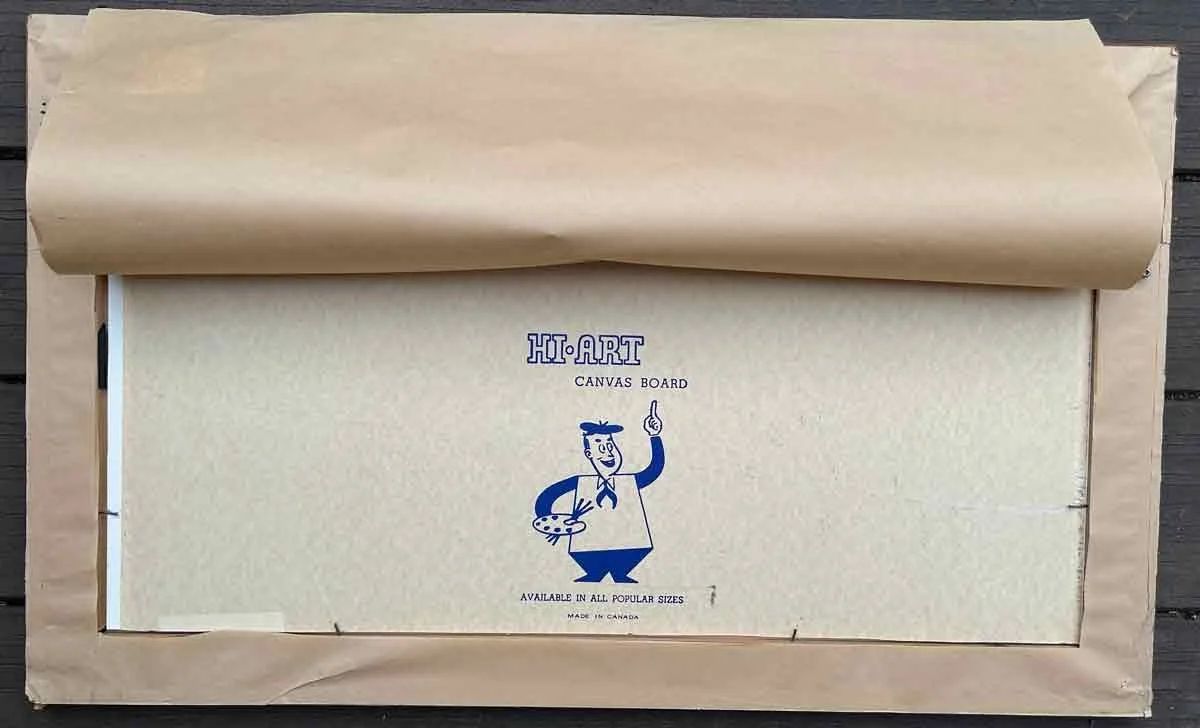
The back of the painting doesn’t show any additional information.