Augustine C. Frey
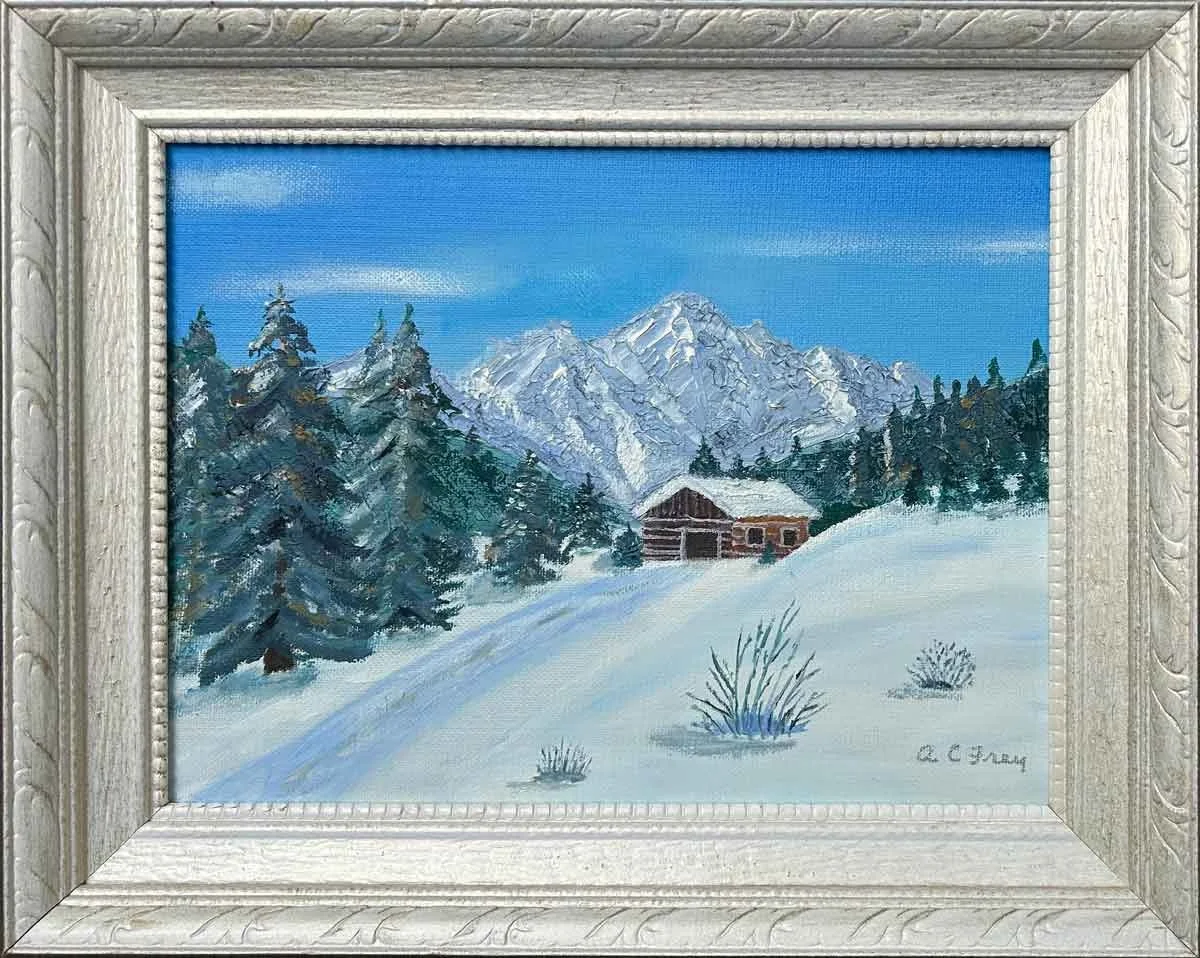
Log Cabin
Augustine Frey
1985
Oil on canvas board, 12” x 9”
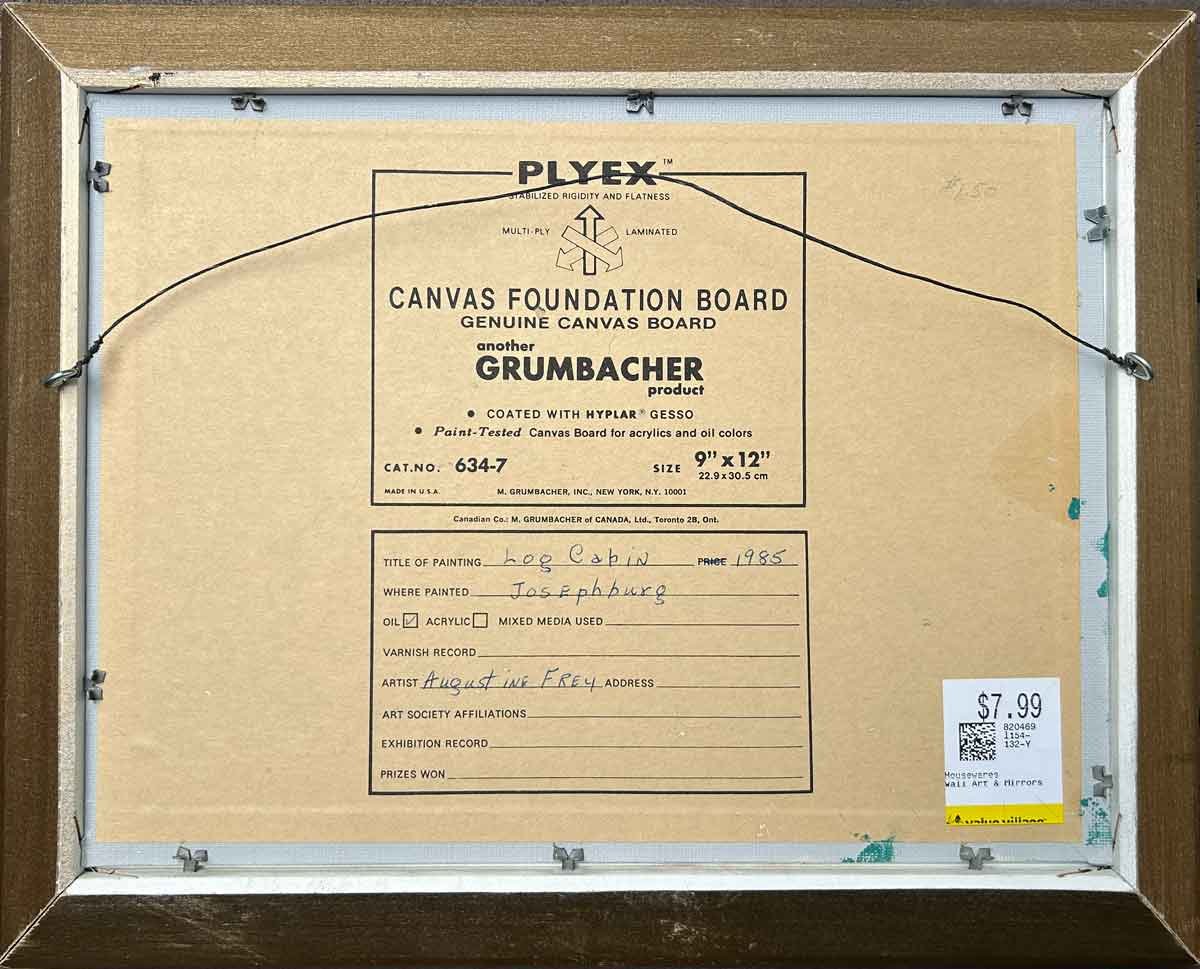
Back of Log Cabin by Augustine Frey
This winter landscape is signed A. C. Frey on the front and fully identified on the back: Log Cabin, painted in 1985 in Josephburg, Alberta, by Augustine Frey. The clarity of the inscription contrasts sharply with the image itself.
The painting depicts a snow-covered cabin nestled among evergreens, with a dramatic, snow-capped mountain rising in the distance. The palette is crisp and cool—icy blues, dense greens, and bright whites—applied with confident, textured brushwork. The composition is traditional and legible, favouring familiarity and calm over experimentation.
What complicates the picture is geography. Josephburg, located east of Edmonton, is prairie land. There are no mountains there—certainly none resembling the one painted so prominently behind the cabin.
This raises questions rather than errors. The inscription may indicate where the painting was made, not what it depicts. The scene could be drawn from memory, travel, photographs, or imagination—filtered through the conventions of Canadian landscape painting rather than strict topographic accuracy. By 1985, Frey would have been in her late seventies, working from a lifetime of visual references rather than direct observation.
Very little documentation survives for Augustine C. Frey beyond a cemetery listing in Josephburg (1907–2000). No exhibition records, no biographies, no known body of work. And yet here is a painting that is careful, assured, and complete—clearly made by someone who had painted before, and often.
Purchased at Value Village, this work carries both certainty and contradiction: a named artist, a titled work, a dated moment—and a landscape that refuses to align neatly with place.
This painting matters because it reminds us that truth in painting is not always geographic.
For many regional and amateur artists, landscapes were not documents but composites—built from memory, aspiration, and shared visual language. Mountains, cabins, snow, and evergreens formed a shorthand for solitude, resilience, and the idea of “elsewhere,” even when painted far from those sites.
Augustine Frey’s Log Cabin sits at the intersection of record and imagination. The back of the painting insists on authorship and location; the front quietly disagrees. That disagreement is not a flaw—it’s evidence of how people painted the worlds they carried with them, not just the ones outside their windows.
Works like this rarely enter formal histories because they don’t fit clean categories. They are too personal to be documentary, too competent to be dismissed, and too ordinary to be canonized. And yet they tell us how landscape functioned in everyday creative life: as memory, as desire, as a place to rest the eye.
This painting survives because someone made it carefully, labeled it deliberately, and kept it long enough for it to be found again. That is reason enough to look closely.