C.A. Elkow
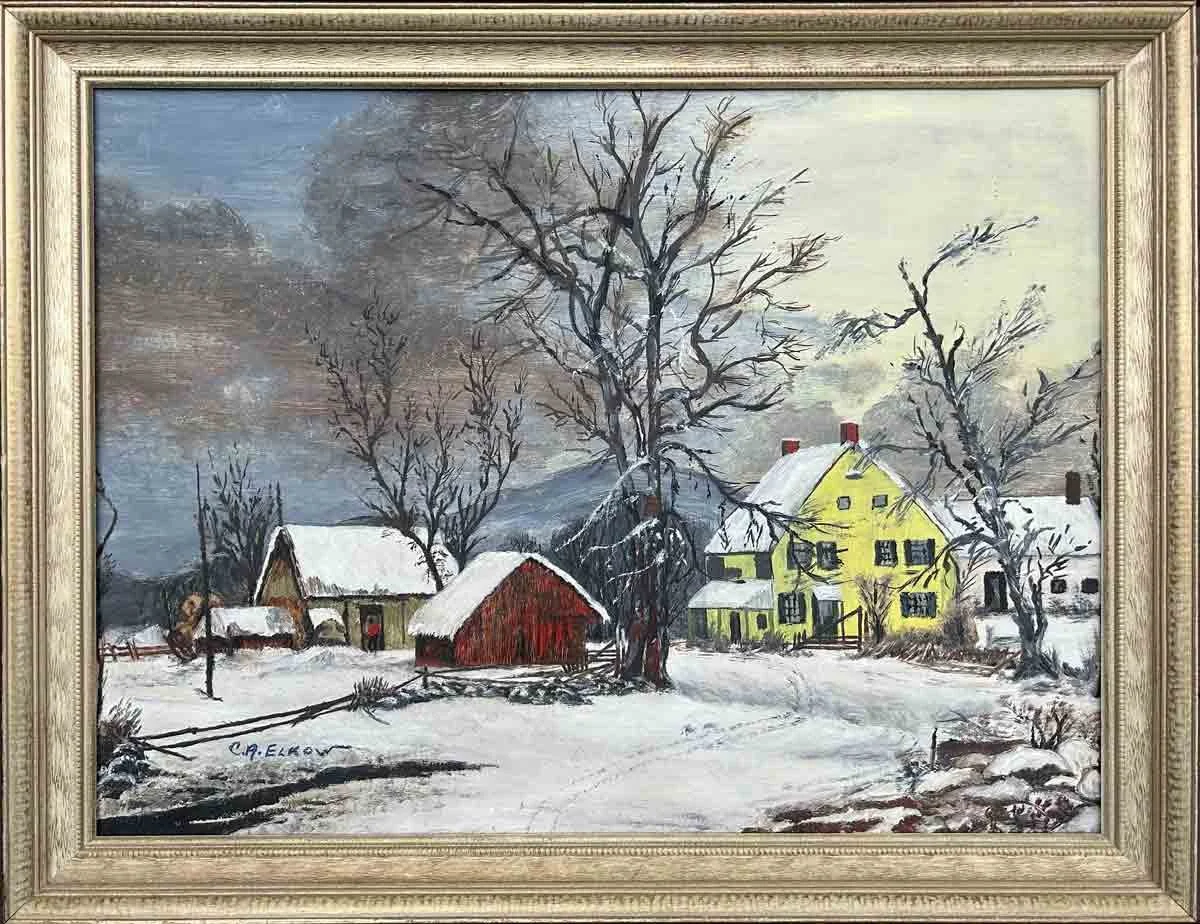
Untitled (After Currier & Ives)
C.A. Elkow
Paint on artist’s board
Untitled (After Currier & Ives) — Attributed to C.A. Elkow
Paint on artist’s board
Signed lower left “C.A. Elkow”
Mid-20th century (likely)
Purchased second-hand
This winter landscape depicts a rural farmstead with a yellow farmhouse, red outbuilding, and leafless trees set against a snow-covered ground. A fence line and path lead the eye through the composition, creating depth and movement within an otherwise still scene.
The composition closely follows Winter in the Country: A Cold Morning (1864), a lithograph published by Currier & Ives. That image became one of the most widely circulated rural winter scenes in North American print culture and was frequently used throughout the 20th century as reference material by painters working in community, instructional, and informal settings.
Rather than a direct copy, this work represents a hand-painted interpretation of a familiar visual template. Differences in colour handling, brushwork, and spatial emphasis suggest personal decision-making rather than mechanical reproduction. The painting prioritizes atmosphere and painterly texture over narrative detail.
This painting matters because it shows how images are remembered through repetition.
Long before digital sharing, certain pictures became common visual language. Currier & Ives scenes were pinned to walls, printed in books, used in classrooms, and absorbed into collective memory. For many painters, learning to paint meant learning through those images—re-entering them by hand.
What’s compelling here is not originality in the modern sense, but participation. By repainting a widely known composition, C.A. Elkow wasn’t copying an image so much as inhabiting it—using a shared structure to practice seeing, making, and resolving a painting.
As a collector, I value this painting because it reminds me that art history doesn’t only advance through rupture. Sometimes it moves forward through quiet continuity—through people who made work not to be remembered, but because making it mattered to them.
This painting isn’t rare because of its subject.
It’s rare because it survived as a singular object in a tradition built on repetition.

Back of painting by C.A. Elkow