Eglantina Perlorea Swartz
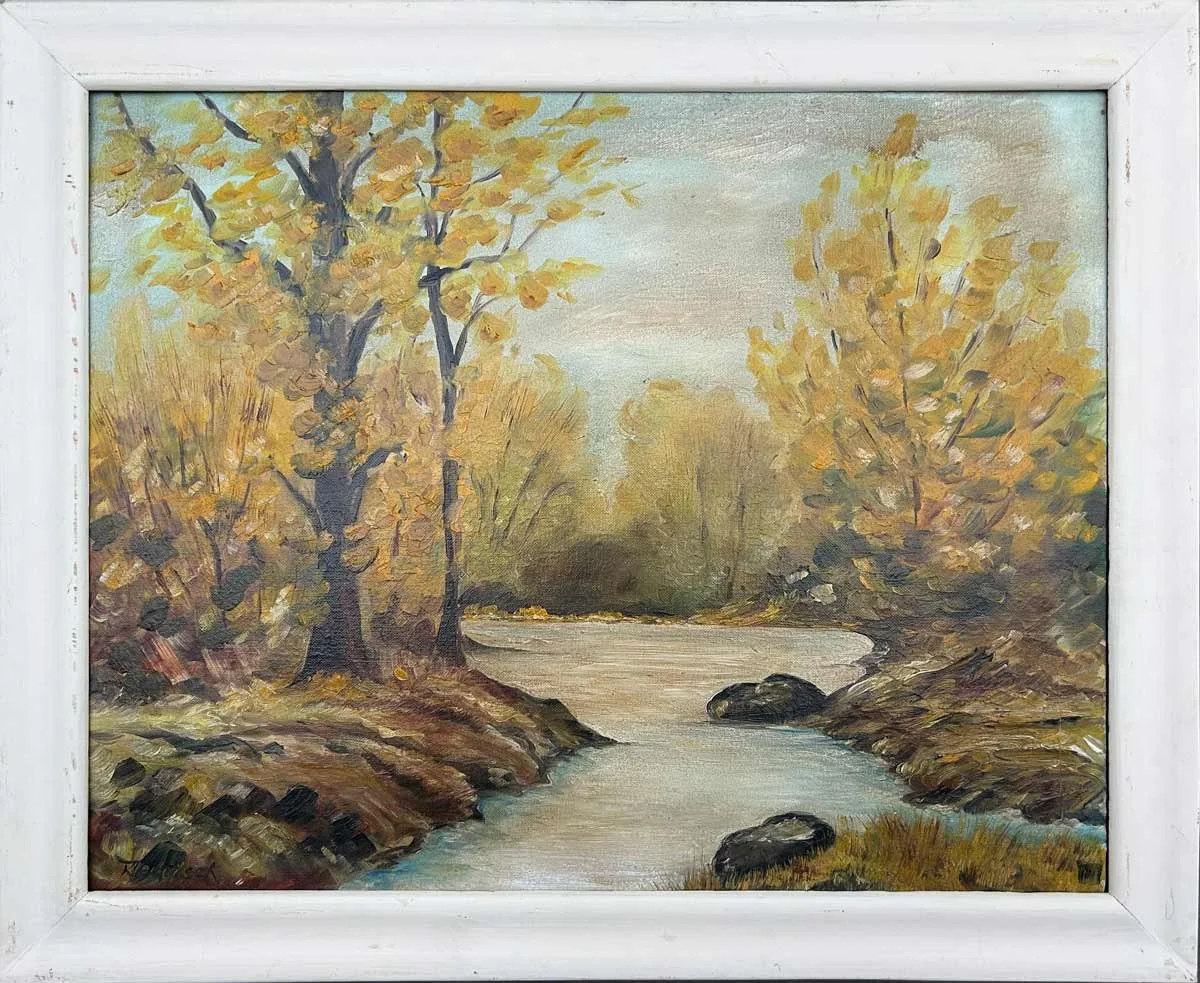
Untitled landscape
Eglantina Perlorea Swartz
Dated June 9, 1968
Paint on Artist’s Canvas Board (Winsor and Newton, Made in Canada)
20” x 16”
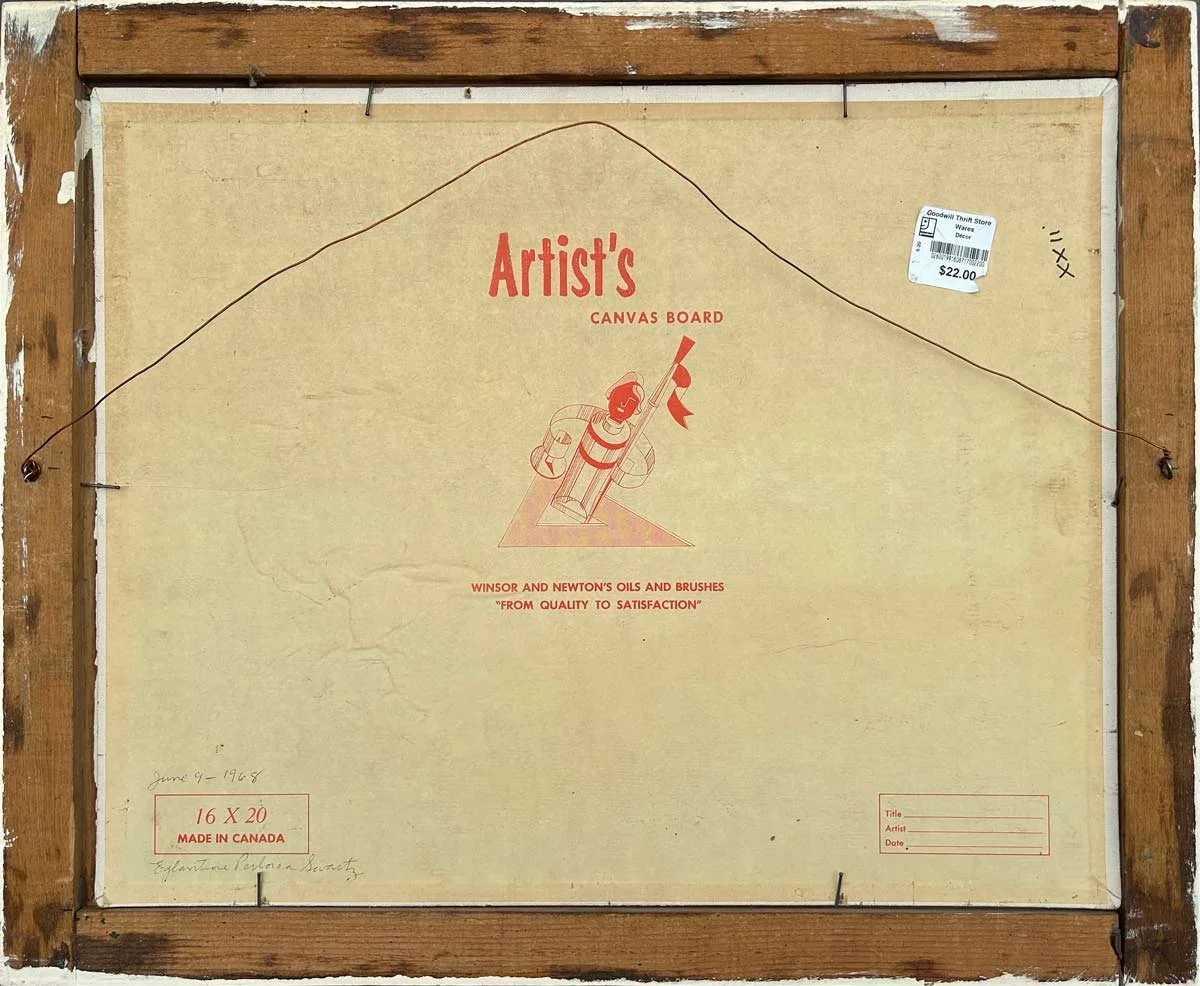
Back of landscape by Eglantina Perlorea Swartz
Untitled Landscape
Paint on artist’s canvas board (Winsor & Newton, Made in Canada)
20” × 16” (framed approx. 23” × 19”)
Signed and dated June 9, 1968
Purchased at Goodwill, 2023
This landscape depicts a quiet creek bordered by autumn trees, their leaves rendered in warm yellows and ochres. The water moves gently through the centre of the composition, flanked by soft banks and scattered rocks. The scene is calm and observational, with no human presence—focused instead on seasonal transition and stillness.
The painting is signed and dated on the back: June 9, 1968. It is executed on a Winsor & Newton artist’s canvas board manufactured in Canada, a practical support commonly used by painters working outside commercial studio systems.
The artist, Eglantina Perlorea Swartz (1907–1976), lived in Darwell, Alberta, and is buried in the Darwell Cemetery in Lac Ste. Anne County. No formal exhibition history is currently known.
This painting matters because it represents a kind of artistic life that rarely leaves a trace beyond the object itself.
Eglantina Swartz was not a public-facing artist in the conventional sense. There are no records of galleries, awards, or institutional affiliations. What remains is this painting—carefully dated, deliberately signed, and made on quality materials. That alone tells us that the act of painting held importance in her life.
The date is especially telling. June 1968 places this work late in her life, made not as a youthful experiment but as a sustained practice. This wasn’t a casual or accidental object; it was something she chose to make, name, and keep identifiable.
For women working in rural communities in mid-century Alberta, creative work often existed alongside domestic, agricultural, and community labour. It was practiced privately, shared locally, and rarely documented. Paintings like this survive not because they were collected at the time, but because someone—perhaps the artist herself, perhaps her family—believed they were worth holding onto.
As a collector, I’m drawn to this piece because it collapses distance. The painting isn’t anonymous anymore. It carries a name, a place, and a date. It reminds us that art history isn’t only shaped by institutions, but by individuals who made work quietly, for reasons that didn’t require validation.
This painting doesn’t ask to be rediscovered. It simply asks to be seen—again.