Percy Henry Edgar Henson
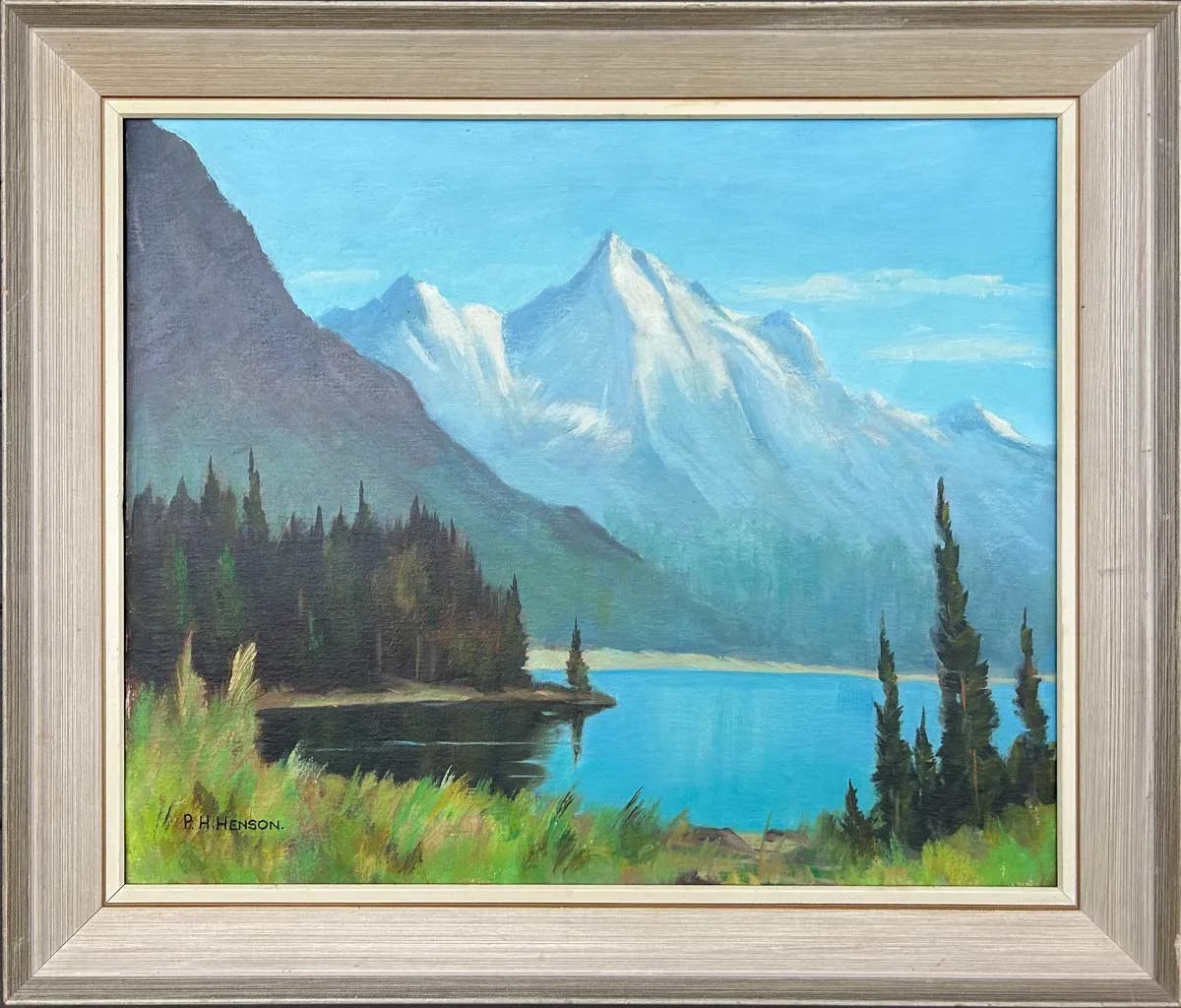
P.H. Henson
Medicine Lake, Jasper Park Lodge
Demonstration panel
May 19, 1970
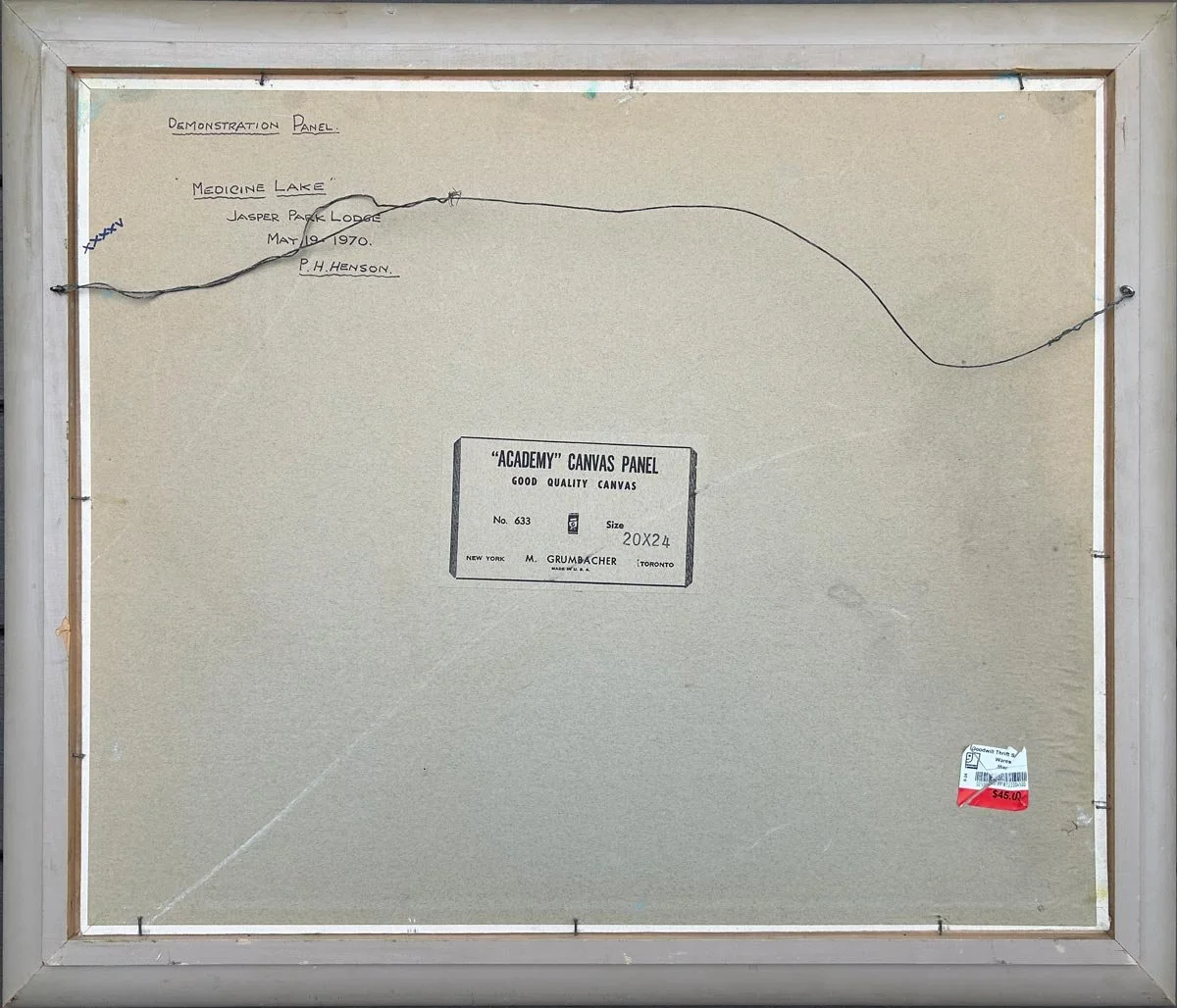
Back of Medicine Lake, Jasper Park Lodge by P.H. Henson
Medicine Lake, Jasper Park Lodge — P.H. Henson
Demonstration panel, May 19, 1970
Academy canvas panel, 24” × 20”
Signed on front and fully inscribed on back
Purchased second-hand
This painting depicts Medicine Lake near Jasper Park Lodge, with mountain peaks rising behind a calm expanse of water and a foreground of grasses and evergreens. The composition balances strong vertical forms with open sky and water, creating a sense of depth and quiet monumentality.
The work is signed on the front “P.H. Henson” and inscribed on the back as a Demonstration panel, dated May 19, 1970. The inscription indicates the painting was created as part of a live teaching or instructional context, rather than as a studio piece intended primarily for exhibition or sale.
The artist, Percy Henry Edgar Henson (1890–1975), was a late-blooming painter who began working seriously in art at the age of fifty. He studied at summer schools at the Ontario College of Art and the Banff School of Fine Arts, served as a Director of the Edmonton Art Gallery from 1951 to 1964, and later taught landscape painting through the University of Alberta’s Department of Extension. His work is known for representational landscapes informed by modern abstract design principles.
This painting matters because it captures art as an act of sharing, not just making.
As a demonstration panel, this work wasn’t created in isolation. It was made in front of others—students, peers, or observers—while explaining decisions, techniques, and ways of seeing. The brushstrokes carry not only the image of Medicine Lake, but the moment of instruction itself: how to simplify a mountain, how to organize space, how to balance realism with design.
Henson’s biography is unusually well documented for someone whose work often feels modest and restrained. He came to painting later in life, after a long career in community service, and remained deeply invested in building arts infrastructure in Alberta. That context reframes this painting: it isn’t about artistic ego or legacy-building, but about participation, mentorship, and continuity.
What makes this piece especially compelling as a collected object is the specificity of its inscription. The date, location, and purpose anchor it in time. It tells us not just what Henson painted, but why he was painting that day.
Held now outside the classroom, the demonstration panel continues its quiet work—still teaching, still showing how a place can be translated into paint, still carrying forward a moment that was never meant to be precious, only useful.