Mary Siebert
Walter’s Last Stook by Mary Siebert
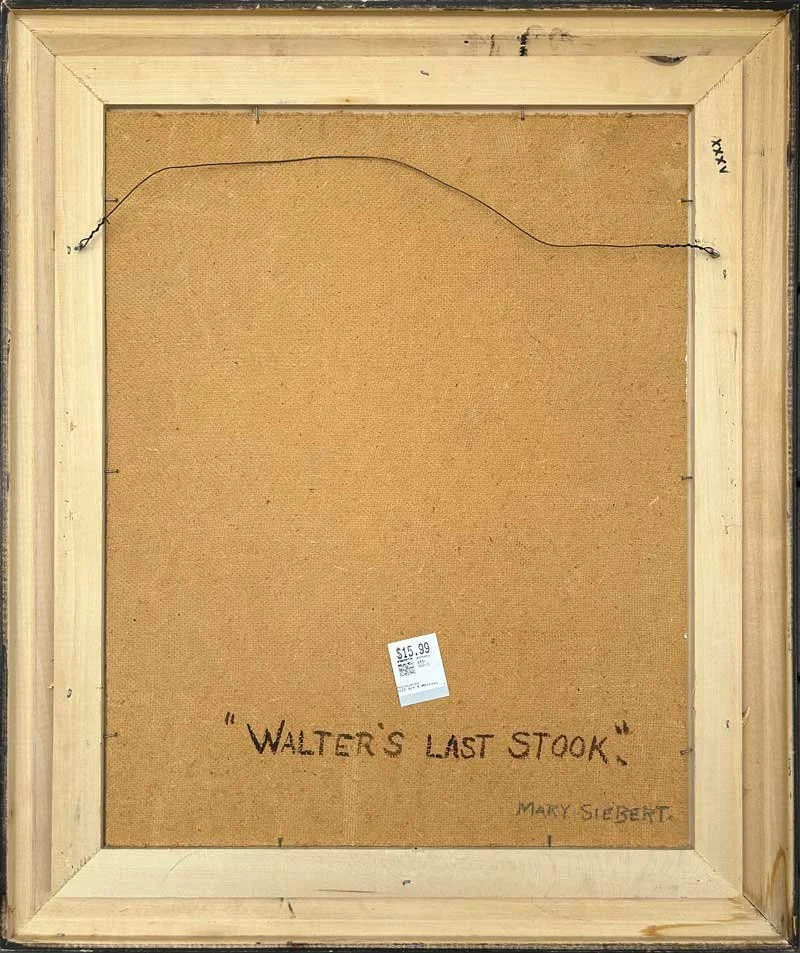
Back of painting by Mary Siebert
Walter’s Last Stook
Mary Siebert
Undated
Oil or acrylic on board, 16 × 20 in.
Walter’s Last Stook is a figurative prairie landscape painting signed by Mary Siebert on both the front and back of the canvas. The title is handwritten on the reverse. The painting depicts a solitary figure standing in a harvested grain field, surrounded by stooks—bundles of grain sheaves set upright to dry—set against a treeline and open sky.
No date is recorded on the work. The painting was acquired at Value Village in Edmonton in 2023. While multiple individuals named Mary Siebert lived in Alberta and Saskatchewan, one documented Mary Siebert (née Klassen, 1924–2013) lived and farmed in the La Glace and Hythe areas of Alberta and was known to enjoy painting alongside gardening and crafts. No definitive attribution beyond the signature has been established.
I’m drawn to this painting because it names something specific and fleeting: the last stook. The title alone suggests an ending—of a season, of a way of working, or of a life shaped by labour and land. Even without a confirmed date, the subject anchors the painting in a time when practices like stooking were part of everyday prairie life, and when those moments were familiar enough to be painted without explanation.
Paintings like this often sit at the intersection of work and memory. They record agricultural knowledge that was once common and is now largely historical, not through documentation but through lived experience. The figure in the field isn’t idealized or distant; he stands firmly within the work he has done, surrounded by the visible evidence of it.
As a collector, I’m interested in how these paintings quietly preserve stories that were never formally archived. They surface through thrift stores rather than institutions, carrying names and titles but few official records. Collecting them is a way of holding space for the people, practices, and places that shaped everyday life—and acknowledging that art has long existed as a means of remembrance, even when it wasn’t made for an audience beyond home and community.